
Welcome to the fourth session of ScriptRemix!
Part 1: Three-Act Structure
Here we start looking at how to build a story framework and where we can plug the people and places we’ve been playing with into our scripts.
resources
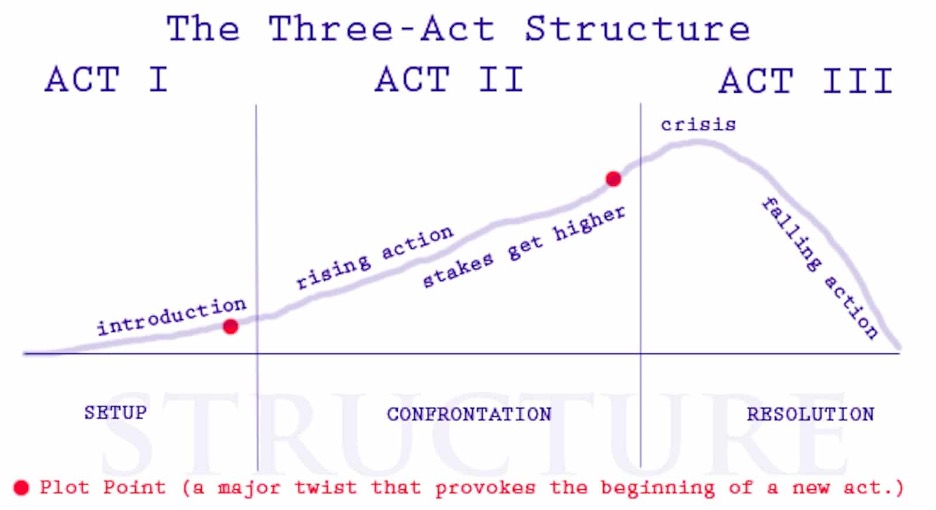
Here is a visual outline of a basic three-act structure:
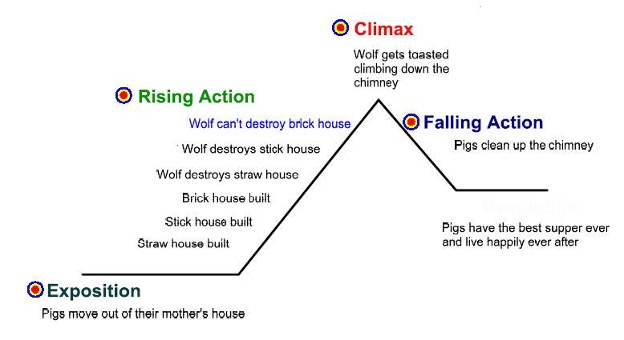
Here is a structural outline of The Three Little Pigs:
Here is the 1993 Disney version of The Three Little Pigs. It’s where the song “Who’s Afraid of the Big Bad Wolf” first appeared.
EXERCISE: Rough Outline (15 Minutes)
Let’s take the characters, settings, and scenes that you’ve come up with so far, and write them out in point form (maybe adding needs, desires, and/or impediments as well). You’ll need:
- 1-2 scenes to set things up and get going with the inciting incident;
- At least 3 scenes to fill out the middle and build to a climax;
- 1-2 scenes to send your characters on their way with whatever changes or knowledge they’ve gained over the course of the story.
You might want to write each scene on an index card if you need to reorganize them later. You can also write snippets of dialogue and action on the cards to use when you start drafting your script.
Part 2: Short Scripts
We take a look at short-form scripts (on a scale that you might be able to produce with limited resources) and David submits one of his unproduced short screenplays for your consideration.
EXERCISE: Case Study Reading (15 Minutes)
Here’s a script I [David] wrote for screenwriting class a couple of years ago. While reading it, think about how you might take your story and its elements and have them play out in as few locations as possible. It’s also a sample of script formatting which you can refer to for Session 5. Download link is available below.
Part 3: The Hero’s Journey
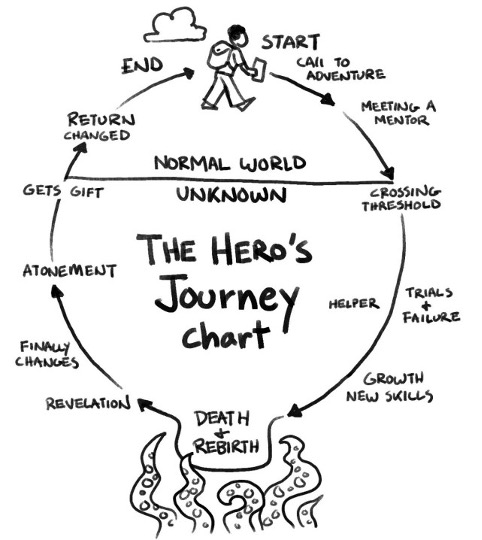
In this video we discuss a more complex structure that has its roots in a variety of cultures’ myths, sacred texts, and epics. George Lucas popularized this form with Star Wars, and you can see it at work in The Hobbit and The Lord of the Rings. Apocalypse Now, The Matrix and the Harry Potter movies all fit the mold as well.
resources
- The University of Berkeley’s Monomyth site, which goes into detailed context of several cultures’ epics.
- Kurt Vonnegut’s amusing short video about structure from Monomyth.
EXERCISE: Outline (15-30 Minutes)
Try using your point-form notes and/or index cards to write an outline that reads like a short story. It should be no more than two pages long and include:
- One paragraph for act one and the inciting incident;
- Three or four paragraphs for the rising action and complications;
- One paragraph for the climax;
- One paragraph for the denouement of falling action.
Feel free to add as much detail about setting and character as you like and key bits of dialogue if you feel it moves the story along.
Wrap Up
Now that we’ve got the raw materials – character, setting, and story structure – in place, we can move on to the next session, where we roll up our sleeves and begin writing. We’ll also provide you with the word processing tools you need to format a professional-looking script.
 newshoots.ca