
Welcome to the fifth session of ScriptRemix!
Part 1: Formatting Your Script
Here is a discussion of the nuts and bolts of formatting your scripts, along with some word processing tools for you to try.
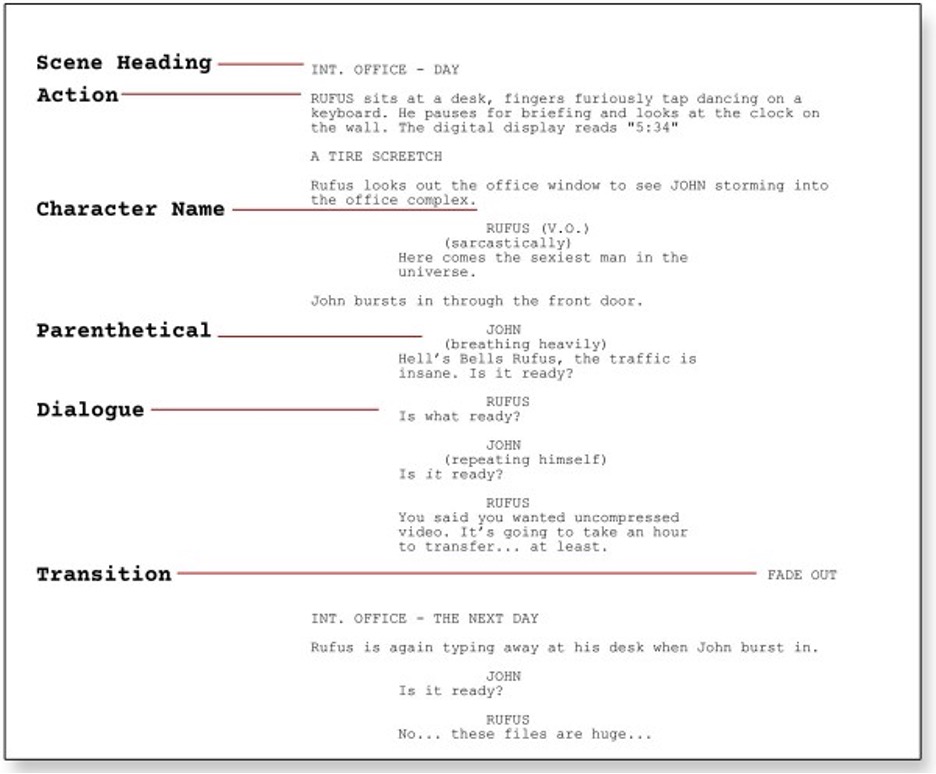
Resources
- ScreenCraft: How to Format a Script
- Here’s a Word template (if you open up the “Styles” bar, you can navigate through the various script elements), but there are easier ways to get going, such as:
- Celtx – There is a free “Basic Screenwriting” version that lets you work on 3 projects, which should be enough to get you started. You may have to scroll past the paid options to find the free one near the bottom of the sign-up page.
- WriterDuet – Another free online screenwriting software option.
EXERCISE: Begin Formatting (15 Minutes)
Choose your software and start plugging in scenes, locations, and dialogue. The programs have a useful index card function that allows you to play around with the structure of your script.
Alternatively, you could use a Word template or draft by hand.
Part 2: What Makes for Dynamic Dialogue?
Your characters’ voices, dialogue, and interactions with one another are the pulse and lifeblood of your script/story. In this video you will learn more about what makes for immersive, engaging and memorable dialogue that moves your story forward, reveals information about your character, and contributes to the tone, style, and aesthetic of your story.
Resources
EXERCISE: Character Interview (20 minutes)
Put your timer on for this one!
Consider how your character speaks. Do they have an accent? Do they speak in long-winded sentences? Have they had a lot of power and space in life? How does that impact how they speak? How is class shown through the way they speak? Are they educated? Do they have something to prove?
Then answer the following 10 questions as though your character were being interviewed via e-mail by a journalist. If you want to record yourself speaking as your character, that works too.
- Do you think you are important in the world?
- Are you smart?
- Do you have any close friendships?
- Do you like to be alone?
- Do you think the world is generally a good place?
- What do you want?
- What is in your way?
- Do you think you deserve to get what you want?
- What is something you can’t live without?
- What is something you absolutely hate?
Part 3: Three Levels of Conflict in Scene-Building
Every good script and scene requires tension and conflict (opposing forces, obstacles, a pulse) that creates a momentum and drive to the action. In this video you will learn about three different levels of conflict to build in your story and in your scene.
EXERCISE: Scene of Interpersonal Conflict (15 minutes)
Put your timer on and write a scene between the protagonist and antagonist where the antagonist is stopping the protagonist from getting what they want.
Before you write the scene, revisit three things your protagonist wants. Circle what they want the most. What are three things the protagonist does to try and get what they want (these are called tactics)? What does the antagonist want? Write down three things the antagonist does to get what they want.
Keep this in mind as you write the dialogue between the protagonist and antagonist.
Wrap Up
So, you have a great story – how will you communicate it clearly to others to pique their interest as you continue to develop your script? Now that you have looked at the essential facets involved in building a scene (from formatting, to dialogue, to conflict), we will move on to our final session.
 newshoots.ca